Overview
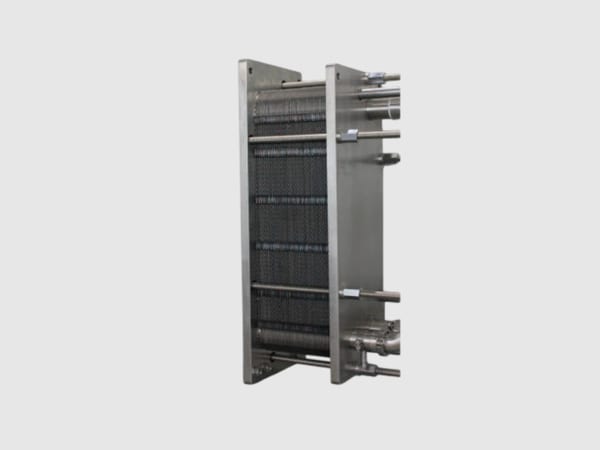
The Plate Heat Exchanger (PHE) is the core thermal processing unit in continuous-flow HTST (High Temperature Short Time) pasteurization lines. It transfers heat between the raw incoming milk and the already-pasteurized outgoing milk with exceptional energy efficiency, reducing external heating and cooling energy consumption by up to 90% through regeneration. Corrugated stainless steel plates are clamped together in a frame, creating alternating channels through which hot and cold fluids flow in opposite directions. The turbulent flow induced by the corrugation pattern maximizes the convective heat-transfer coefficient, achieving very high thermal efficiency in a compact footprint. In a three-section PHE (regeneration, heating, cooling), raw milk first picks up heat from the hot pasteurized milk, is then raised to pasteurization temperature by hot water, held in a tubular holding tube for the required dwell time, and finally cooled against incoming raw milk and chilled water.
Working Principle
Raw milk enters the regeneration section where it absorbs heat from the outgoing hot pasteurized milk, recovering up to 92% of the thermal energy that would otherwise be wasted. The pre-heated milk then passes through the heating section where hot water raises it to the pasteurization temperature (72 °C for 15 seconds in standard HTST). After the holding tube confirms the required dwell time, the pasteurized milk re-enters the PHE in the regeneration section, giving up its heat to the incoming raw milk. A flow-diversion valve (FDV) with a temperature interlock automatically diverts under-pasteurized milk back to the raw milk balance tank if the temperature sensor detects any deviation from the set-point. The modular plate design allows capacity to be increased simply by adding plates, without replacing the entire unit.
Applications
The Plate Heat Exchanger is used in pasteurized milk, UHT milk, yogurt, cream, fruit juice, and beverage production lines. It is also used for heating CIP solutions, cooling products prior to cold storage, and energy recovery in any process where hot and cold streams need to exchange heat efficiently.